PIERCING
Piercing studio
All piercings for CHF 50.– including high-quality initial jewellery and professional consultation at a fair price.
Why should you choose me to do your piercing?
- A piercing is a matter of trust. That is why I combine medical expertise, the highest hygiene standards and personal care – transparent, responsible and in line with Swiss quality standards.
- As a qualified pharmacist, I have extensive knowledge of anatomy, wound healing, material compatibility and infection prevention. This expertise forms the foundation of my work and serves your safety.
- I work according to strict hygiene guidelines. All instruments are sterilised using an autoclave to minimise risks as much as possible. For piercing procedures, I exclusively use sterile single-use needles. Hygiene and care are my top priorities.
- When placing a piercing, I focus not only on technical precision but also on an aesthetically harmonious result, tailored to your individual anatomy.
- I use exclusively high-quality titanium jewellery and deliberately avoid nickel-containing materials as well as conventional surgical steel. Titanium is considered particularly well tolerated and is therefore my material of choice.
- Suitable aftercare products can be purchased directly from me. Of course, you will receive detailed aftercare instructions.
- I am also available to advise you after the piercing, should any questions or uncertainties arise.
- I take time for you, explain the procedure and possible risks clearly, and work without haste. Honest advice, quality and trust are at the heart of my work.
For everyone who values safety, quality and professional care.
EAR PIERCINGS
- Lobe – In the earlobe; the most common, heals quickly.
- Upper Lobe – Upper part of the earlobe; slightly longer healing time.
- Helix – Outer rim of the ear; cartilage piercing, more sensitive.
- Forward Helix – Front part of the helix close to the head; usually small jewelry.
- Double / Triple Helix – Two or three helix piercings placed next to each other.
- Flat – Flat cartilage area in the upper ear; suitable for larger designs.
- Industrial / Scaffold – Two piercings connected by one long bar; difficult healing.
- Conch (Inner / Outer) – Inner or outer part of the ear shell; versatile placement.
- Tragus – Small cartilage in front of the ear canal; may interfere with headphones.
- Anti-Tragus – Opposite the tragus.
- Daith – Inner cartilage fold above the ear canal; often associated with migraine relief (not scientifically proven).
- Rook – Upper inner cartilage ridge; thick cartilage.
- Snug – Inner cartilage on the outer side of the ear; more painful and slow to heal.
LIP PIERCINGS
- Labret – Centered below the lower lip; may irritate gums.
- Vertical Labret – Runs vertically through the lower lip; no contact with teeth.
- Lowbret – Lower-positioned labret closer to the chin.
- Side Labret – Placed on one side below the lower lip.
- Snake Bites – Two symmetrical side labret piercings.
- Spider Bites – Two piercings close together on one side.
- Dolphin Bites – Two piercings close together in the center.
- Angel Bites – Two piercings on the upper lip, left and right.
- Monroe – Upper lip, left side; resembles a beauty mark.
- Madonna – Same as Monroe, but on the right side.
- Medusa (Philtrum) – In the groove between the nose and upper lip; very prominent.
- Jestrum – Vertical Medusa piercing passing through the upper lip.
FACIAL PIERCINGS
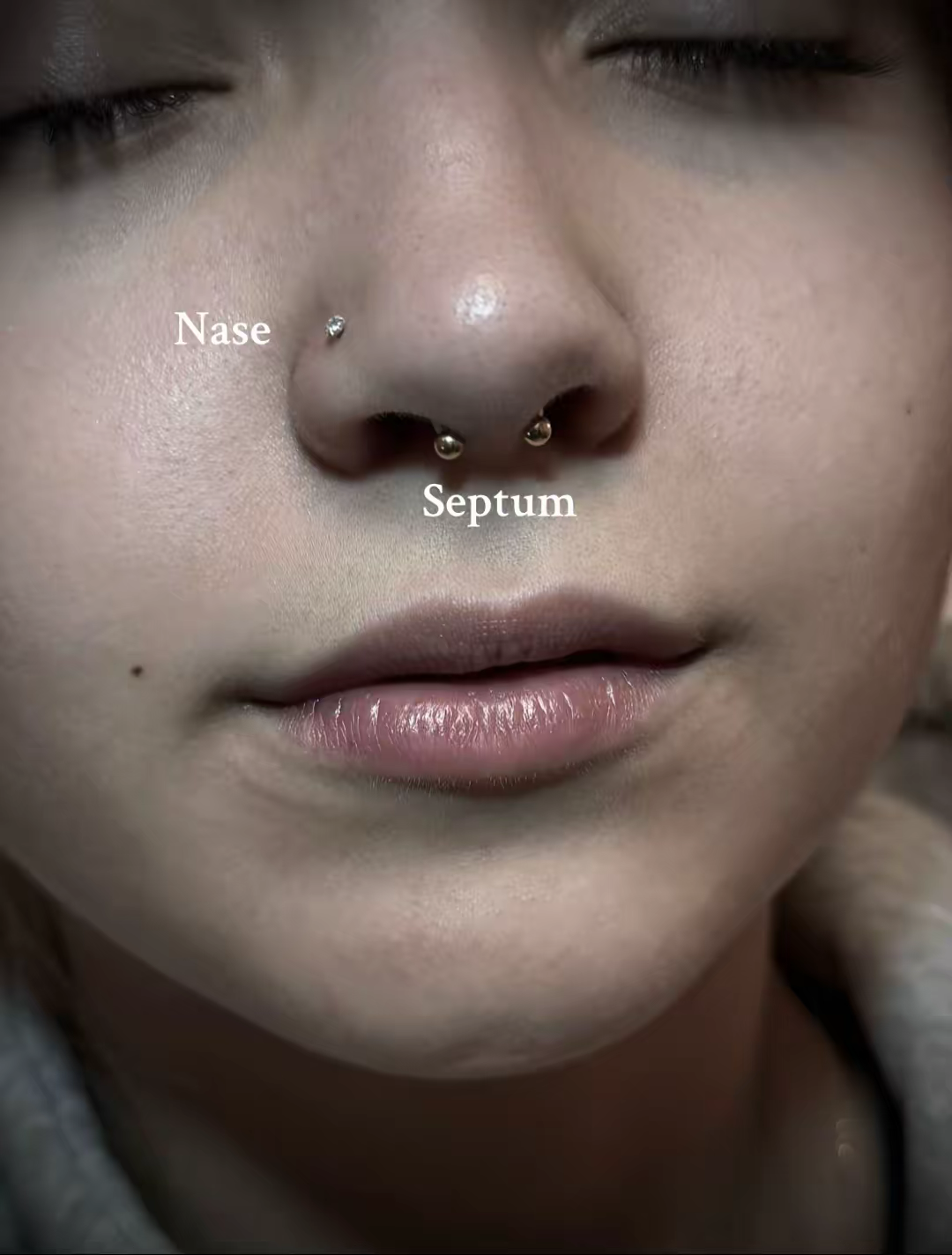
- Nostril – Nostril; classic nose piercing.
- High Nostril – Higher on the nostril; longer healing time.
- Septum – Through the nasal septum “sweet spot”; can be hidden easily.
- Bridge (Erl) – Surface piercing on the bridge of the nose.
- Eyebrow – Through the eyebrow; usually a curved barbell.
- Anti-Eyebrow / Teardrop – Below the eye on the cheek; surface piercing.
- Cheek / Dimple – Cheek piercing at dimple area; higher risk due to nerves.
- Temple – Temple area; very rare.
ORAL & TONGUE PIERCINGS
- Tongue – Center of the tongue; risk of tooth and gum damage.
- Tongue Web – Frenulum under the tongue; subtle and discreet.
- Frowny – Lower lip frenulum; rare, usually heals quickly.
- Smiley – Upper lip frenulum; may damage tooth enamel.
BODY PIERCINGS (OTHER)
- Nipple – Nipple; long healing time and very sensitive.
- Navel / Belly Button – Classic navel piercing; anatomy-dependent.
- Inverse Navel – Pierced above the navel.
- Chest / Décolleté – Upper chest area; usually a surface piercing.
- Cleavage – Between the breasts.
- Neck / Nape – Back of the neck; typically dermal or surface.
- Dermal Anchor / Microdermal – Single-point jewelry; can be placed almost anywhere.
- Surface Piercing – Two exit points; used on flat body areas (e.g. collarbone, wrist).
Piercing prices
Professional replacement of your piercing jewellery
Safe removal of piercings
Inspection and consultation for your existing piercing Online/telephone consultation: free of charge
Professional cleaning and aftercare consultation
Important Information
- Minors require written parental consent. Piercings are performed on children only from the age of 14. Age is always verified using an official photo ID.
- High-quality titanium initial jewellery is included in the price.
- On-site and telephone/online aftercare consultation is free of charge.
- Piercings that require multiple punctures are charged per puncture.
- I do not perform intimate piercings, surface bar piercings with a very high risk of rejection, or tongue piercings that have been proven to potentially cause nerve damage, such as “Snake Eyes”.
- My goal is to adorn the body aesthetically and responsibly within safe limits. Health, long-term compatibility and the well-being of my clients are always my top priorities.
- Due to individual anatomical conditions, not every person is suitable for every piercing. In such cases, I reserve the right to decline a specific piercing. However, I am happy to advise on safe, anatomically suitable alternatives with good healing prospects and equally aesthetic results.
- After a healing period of 6–8 weeks, the jewellery used for the piercing should be shortened or adjusted in size to avoid healing complications. Initially, longer or larger jewellery is deliberately used to prevent it from embedding into the skin due to initial swelling.
Possible Risks of Piercing
Piercing involves an intervention in the skin and, even when performed professionally, may involve certain risks. Thorough information and proper aftercare are therefore essential.
Infections
There is a risk that bacteria, viruses or fungi may enter the wound during piercing. Insufficient hygiene, poor aftercare or touching the piercing with unwashed hands can increase the risk of infection.
Inflammation
Severe redness, swelling, pain and a sensation of warmth may be signs of inflammation. These often occur when the piercing is mechanically irritated or when aftercare instructions are not followed.
Allergic Reactions
Some people are sensitive to certain materials, especially nickel-containing jewellery. Allergic reactions often present as itching, redness or weeping skin areas.
For this reason, only titanium is used. When titanium is used, the risk of an allergic reaction is almost zero. However, it should be noted that aftercare and cleaning products may also cause allergic reactions in rare cases.
Scar Formation
In some cases, increased scarring or the formation of so-called keloids may occur. The risk varies individually and may be genetically determined.
Bleeding
Depending on the body area, stronger bleeding may occur during piercing, especially in well-perfused areas. Mild bleeding during the first few days after piercing is considered normal and is not a cause for concern.
Nerve Damage
There is a small risk of nerve injury during piercing. This may result in numbness, tingling or persistent pain.
Delayed Wound Healing
Factors such as smoking, stress, certain medical conditions or improper aftercare can prolong the healing process and increase the risk of complications.
Rejection or Migration
The body may perceive the piercing as a foreign object. In such cases, the piercing may slowly migrate or be rejected.
Note
Professional execution, sterile working conditions and consistent adherence to aftercare instructions significantly reduce the risks mentioned above. In the case of persistent symptoms, medical advice should always be sought.



OPENING HOURS
By appointment only
MENÜ
Home
Services
PMU
Tattoo
Piercing
About me
Portfolio
Book an appointment
CONTACT
Bahnhofstrasse 17, 8932 Mettmenstetten, Schweiz
My studio in Mettmenstetten, Canton Zurich, is easily accessible for clients from Affoltern am Albis, Zug, Zurich, The Albis & Säuliamt region.
- Free visitor parking behind the building
- 32 minutes from Zurich main station
- Just a 5-minute walk from the train station! 🙂
+41 78 315 06 50